
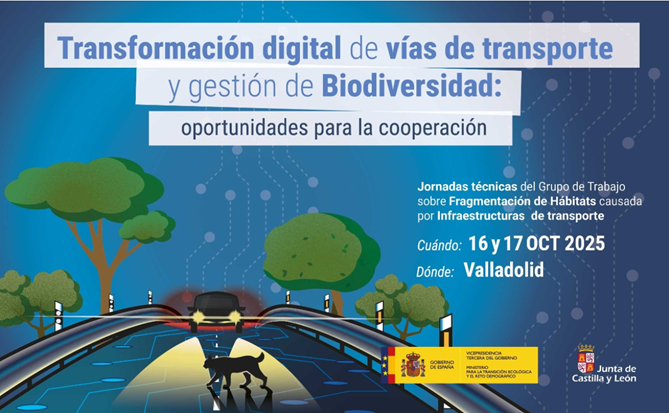
On 16 and 17 October, Valladolid hosted a new edition of the Technical Meetings of the Habitat Fragmentation Working Group, focused on the use of digital technologies and Artificial Intelligence to improve the management of transport infrastructures and advance towards more secure and resilient networks, including actions aimed at conserving biodiversity and supporting adaptation to climate change.
The programme featured international speakers and the presentation of innovative case studies, including solutions to automate biodiversity data collection on roads and railways, as well as technologies to reduce wildlife–vehicle collisions. The new MITECO publication, Metodología para el estudio y análisis de la mortalidad de vertebrados en infraestructuras de transporte, produced in collaboration with the SAFE project, was also presented.
Coordinated by MITECO (Spanish Ministry for Ecological Transition) and co-organised in this edition by the Junta de Castilla y León, the workshops serve as a key meeting point for professionals in transport and biodiversity conservation. They are held biennially, and the first edition took place 25 years ago.
MINUARTIA provided technical support for the organisation, and Carme Rosell and Luis Manuel Fernández participated as session moderators and co-authors of a presentation.
The abstracts are available at Libro de resúmenes de las ponencias iand more information could be found at the MITECO website Here
