
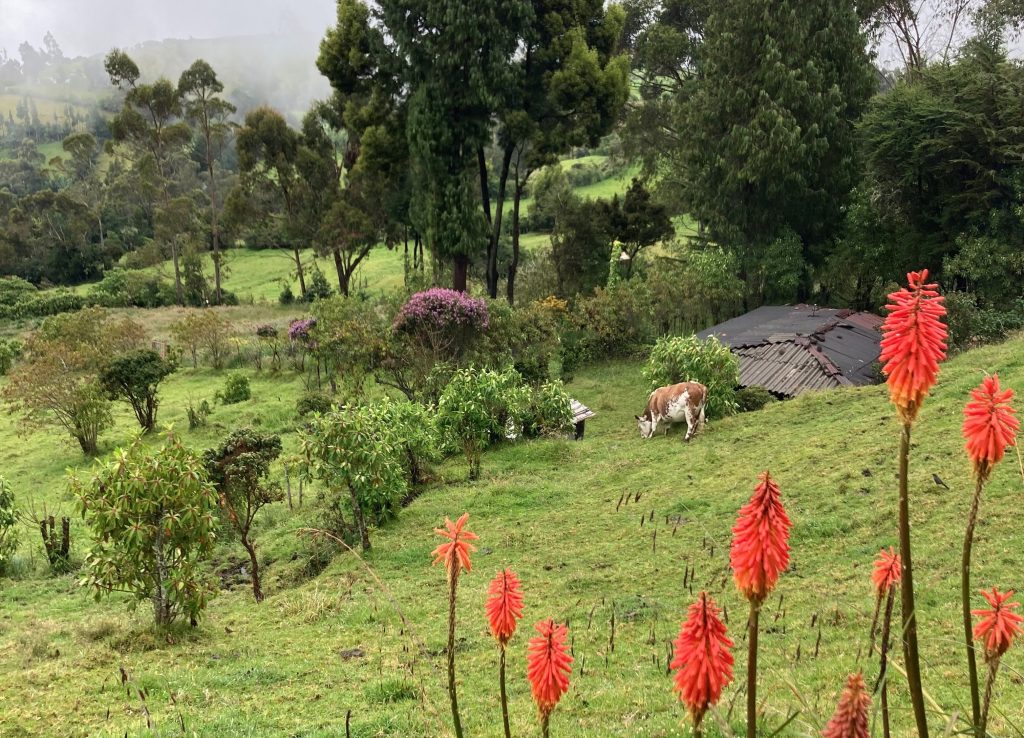
The article Community reconstruction of biocultural landscapes. Application in the Kokonuko Indigenous Territory (https://doi.org/10.1016/j.ecolecon.2024.108447), co-authored by Joan Marull, head of the R&D&I department at MINUARTIA, evaluates how to reverse the socioecological impacts of the Green Revolution in the Puracé Indigenous Territory (high-Andean region of Colombia). The study presents an agroecological transition proposal developed by the Kokonuko community through participatory research, combining indigenous and scientific knowledge.
This territory, whose biocultural landscape has been severely altered by intensive agriculture and mining activities, has undergone a long recovery process through a long fight led by the Kokonuko people. The community, which has even lost its language, aims to restore the landscape as a means to reclaim its destiny through a sustainable lifestyle compatible with its culture.
Reversing the harmful consequences of industrial agriculture requires reducing dependence on non-renewable energy inputs and replacing them with nature-based solutions rooted in the community’s biocultural heritage. This study evaluates traditional agricultural practices through ethnobotanical characterization, biophysical energy metabolism analysis, and landscape assessment.
The results show that traditional agricultural management, implemented through socially integrated polycultures in pilot farms, is multifunctional, highly diverse, and oriented towards food sovereignty and traditional medicine. Furthermore, it exhibits higher energy efficiency compared to industrial monoculture practices, which are more reliant on agrochemical inputs and market-oriented production.
The restoration of traditional management practices in the Indigenous Territory, previously optimized in pilot farms, would facilitate biocultural landscape reconstruction, strengthen Indigenous governance, and restore the traditional multifunctionality that ensured the community’s food sovereignty. In this sense, the conservation of local seeds by the community is essential to promote a global transformative change towards climate change mitigation and adaptation, socioecological landscape functioning, and biodiversity preservation.
